
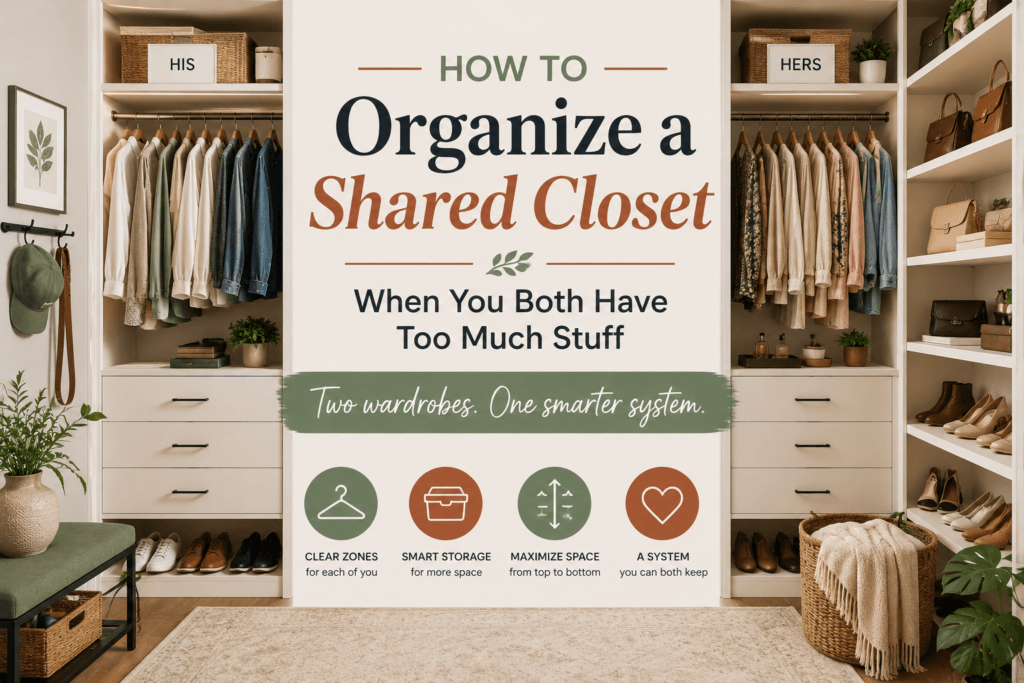
How to Organize a Shared Closet When You Both Have Too Much Stuff
One person needs more hanging space. The other has stacks of folded clothes, shoes on the floor, and a collection of things that somehow keeps moving onto the other person’s side. Before long, a shared closet can feel less like useful storage and more like a daily competition for a few feet of space.
The answer isn’t necessarily a bigger closet. In many cases, the first fix is creating a better system for the space you already have.
A shared closet works best when it reflects two different wardrobes, two different routines, and two different ways of putting things away. Instead of forcing both people into the same organization system, the goal is to create a closet that gives each person the type of storage they actually need.
Different habits. One closet that works for both of you.
Quick Answer: What’s the Best Way to Organize a Shared Closet?
Start by taking everything out and deciding what truly needs to stay in the closet. Then measure the available hanging, shelving, floor, and vertical space. Divide the closet according to each person’s actual wardrobe needs instead of automatically splitting every section exactly in half.
Give each person clearly defined zones, keep frequently used clothing easy to reach, move seasonal or rarely used items elsewhere when possible, and leave a small amount of open capacity so the system doesn’t immediately become overcrowded again.
Why Shared Closets Become So Difficult
Two people rarely use a closet in exactly the same way.
One person may hang most of their clothing while the other folds sweaters, jeans, and T-shirts. One may have a large shoe collection while the other needs more room for work clothes. One may carefully return everything to the same hanger while the other wants a system that takes only a few seconds to maintain.
When the closet treats both wardrobes as if they’re identical, frustration builds quickly.
That’s why a successful shared closet isn’t simply about creating more storage.
It’s about creating the right kind of storage for each person.
The Preference Gap: Organized Doesn’t Mean the Same Thing to Everyone
One person may define organized as “everything completely hidden.”
The other may define organized as “I can see it and grab it quickly.”
vs. Easy to See
vs. Lots of Shelves
vs. Large Wardrobe
vs. Quick & Simple
A good shared-closet system doesn’t require both people to change their habits completely. It gives those different habits a place to coexist.
Step 1: Empty the Closet Before You Organize It
Buying organizers before understanding the problem is one of the easiest ways to waste money.
Start by removing as much as practical from the closet so you can see the actual storage space.
Sort everything into broad groups:
- Keep in the closet
- Store somewhere else
- Seasonal storage
- Donate or sell
- Discard if damaged or unusable
- Undecided
An organizer can rearrange clutter, but it can’t create unlimited storage. Decide what deserves closet space before deciding where it will go.
Step 2: Decide What Actually Needs to Live in the Closet
A bedroom closet doesn’t necessarily need to contain every piece of clothing and every accessory both people own.
Start with the things you use most often.
Frequently worn clothes should usually get the easiest-to-reach locations. Items used only occasionally can move higher, lower, or farther away.
Possible candidates for storage elsewhere include:
- Off-season coats
- Formalwear used only occasionally
- Luggage
- Extra bedding
- Seasonal shoes
- Special-event clothing
- Sentimental clothing you’re keeping but rarely wearing
If deciding who gets which part of the closet is becoming the bigger challenge, see our guide on how to divide a closet between two people .
Having another safe storage location available, moving rarely used items can make the everyday closet dramatically easier to use.
Step 3: Measure the Closet Before Dividing It
Don’t estimate.
Measure the usable areas of the closet, including:
- Hanging-rod width
- Shelf width and depth
- Space above the top shelf
- Floor width and depth
- Unused wall areas
- Door clearance
- Vertical distance below shorter hanging clothes
Those measurements tell you what you actually have to work with and prevent buying storage products that don’t fit.
Step 4: Don’t Assume Fair Always Means 50/50
Dividing a closet exactly down the middle sounds fair.
Sometimes it is.
Sometimes it isn’t.
Imagine one person owns mostly shirts, jackets, and work clothes that need to hang. The other owns more sweaters and jeans that are usually folded.
Giving both people identical hanging sections and identical shelves could actually make the closet less useful.
The question isn’t only, “Did we each get half?”
A better question is: “Does each person have enough of the type of storage their wardrobe requires?”
You may decide on an equal overall allocation while giving one person more hanging room and the other more drawers, cubbies, or shelves.
Step 5: Give Each Person Clear Closet Zones
Shared closets are easier to maintain when ownership is obvious.
Instead of mixing shirts, shoes, accessories, and folded clothes throughout the closet, establish clear personal areas.
Hanging Zone
Give each person an identifiable section for hanging clothes rather than mixing everything along one continuous rod.
Folded Zone
Assign shelves, drawers, or bins based on how much folded clothing each person actually owns.
Shoe Zone
Decide where each person’s shoes belong so the closet floor doesn’t become shared overflow space.
Accessory Zone
Belts, bags, hats, jewelry, ties, and other accessories need a defined home rather than filling whatever empty space remains.
Defined zones also make laundry easier because both people know where things should be returned.
Step 6: Organize Around Your Daily Routines
The best storage location isn’t always the one that looks most attractive.
Think about how each person actually gets ready.
Ask:
- What clothes do you reach for most often?
- Do you get dressed at the same time?
- Does one person leave much earlier?
- Where do work clothes belong?
- Where do workout clothes belong?
- Where do clothes go when they’re worn but not ready for laundry?
- Where does clean laundry wait before being put away?
A closet that anticipates those everyday moments is much easier to keep organized than one designed only to look good in a photo.
Step 7: Use the Vertical Space You’re Already Paying For
Many closets have a surprising amount of unused vertical space.
Look above shelves, below shorter hanging clothes, behind the door, and along unused wall sections.
Depending on your closet, that space could support:
- A second hanging rod
- Additional adjustable shelves
- Stackable shoe storage
- Hooks
- Over-the-door storage
- Small bins or baskets
- High shelves for seasonal items
Every organizer should solve a specific problem. If you don’t know what will live in a new bin, shelf, rack, or basket, don’t buy it yet.
Step 8: Double Hanging Space Where It Makes Sense
If much of your wardrobe consists of shorter items such as shirts, blouses, folded-over pants, or jackets, one full-height hanging rod may waste a large amount of space underneath.
A second rod can create another row of hanging storage.
However, don’t convert every hanging section to double-hang space.
Keep some full-length room for dresses, long coats, suits, jumpsuits, or other garments that require it.
The ideal mix depends on what both of you actually wear.
Step 9: Stop Letting Shoes Take Over the Floor
The floor often becomes the first casualty of an overcrowded shared closet.
A few pairs become a row. The row becomes a pile. Then retrieving one shoe requires moving four others.
Start by deciding which shoes actually need to remain in the bedroom closet.
Then create a defined shoe capacity.
Depending on the available space, that might be a shelf, stackable rack, cubbies, clear boxes, or another simple system.
The important part is that each person’s shoes have a boundary.
Step 10: Create a Small Shared Zone
Not everything in a shared closet needs to belong to one person.
You might have shared items such as travel bags, garment-care supplies, laundry accessories, or other household items.
Give those things a defined shared location rather than allowing them to drift into whoever currently has an empty shelf.
Keeping the shared zone relatively small also prevents it from becoming the closet’s unofficial junk drawer.
Meet in the Middle: Organize for Two Different Habits
The goal isn’t to make both people organize the same way. It’s to design one closet that accommodates different habits without creating constant friction.
| One Person Prefers | The Other Prefers | Meet in the Middle |
|---|---|---|
| Everything hidden | Everything visible | Closed storage for less-used items + open access for everyday clothing |
| Lots of hanging | Lots of folding | Divide storage by wardrobe type instead of identical sections |
| Detailed categories | Simple storage | Detailed system on one side + broad easy-return zones on the other |
| Minimal wardrobe | Large wardrobe | Agree on fair overall capacity while allocating space by actual use |
| Perfectly folded | Fast put-away | Shelves for one person + bins or drawers for the other |
Should You Buy Closet Organizers?
Maybe—but not yet.
First declutter, measure, divide the space, and identify exactly where the system is failing.
Before buying a closet system, make sure the current space is organized around both wardrobes. Start with our guide to organizing a shared closet when you both have too much stuff .
Once you know the problem, a storage product can make sense.
Common problem-and-solution matches include:
Not Enough Hanging Space
Consider a second hanging rod or adjustable closet system if your clothing lengths allow it.
Shoes Covering the Floor
A dedicated shoe rack, shelving system, or stackable storage can establish a clear capacity.
Deep Shelf Piles
Shelf dividers, bins, or drawers may help keep categories from collapsing into each other.
Unused Door or Wall Space
Hooks or door-mounted storage may help with accessories and lightweight everyday items.
We’ll compare specific products separately in our upcoming Best Closet Organizers for Couples Sharing a Closet buying guide.
Create a System You Can Both Actually Maintain
A closet isn’t truly organized if putting something away takes so much effort that neither person follows the system.
The system should work on an ordinary Wednesday when you’re tired—not only on the day you organize the closet.
If someone consistently leaves clothing outside its assigned place, ask why.
Perhaps a drawer is too full. Maybe a shelf is too high. Perhaps five subcategories could become two. Maybe worn-but-not-dirty clothes need their own hook.
Instead of assuming someone is simply being messy, look for friction in the system.
Use a Simple Closet Reset
Even a good system will slowly drift.
New clothes arrive. Seasons change. Laundry backs up. Things get placed wherever there’s room.
Rather than waiting until the closet is completely overwhelmed again, schedule an occasional quick reset.
Shared Closet Reset Checklist
- Return stray items to their correct zones.
- Remove empty hangers you don’t need.
- Put clean clothing away.
- Move seasonal clothing when appropriate.
- Remove shoes that migrated into the wrong area.
- Check whether shelves or drawers are becoming overfilled.
- Set aside clothing you’re ready to donate.
- Make sure each person still has usable space.
Common Shared-Closet Mistakes
Buying Organizers Before Decluttering
More bins can’t fix a closet that simply contains too many things. Determine what needs to stay before adding storage products.
Assuming Everyone Needs the Same Storage
One wardrobe may need hanging space while the other needs shelves. Organize around what each person owns and wears.
Using Every Inch of Available Space
A closet filled to 100 percent capacity is difficult to maintain. Some breathing room makes it easier to put things away and accommodate normal wardrobe changes.
Ignoring the Closet Floor
Undefined floor space quickly becomes overflow storage. Decide exactly what belongs there.
Making the System Too Complicated
An elaborate system may look impressive but fail during normal daily life. Make putting things away as easy as possible.
Allowing One Side to Slowly Expand
Revisit the boundaries occasionally. If one person’s wardrobe changes, discuss the storage problem instead of letting items gradually migrate into the other person’s zone.
Frequently Asked Questions About Shared Closet Organization
How should two people divide a shared closet?
Start with each person’s actual storage needs. You can divide the overall closet fairly without making every individual section identical. One person may need more hanging space while the other uses more shelving or drawers.
What if one person has more clothes than the other?
First decide what truly needs to stay in the shared closet. Then agree on a reasonable amount of overall space for each person. If one wardrobe is considerably larger, seasonal storage, a dresser, under-bed storage, or another available location may help relieve pressure on the closet.
How do you organize a very small closet for two people?
Prioritize everyday clothing, use vertical space, separate personal zones, consider double hanging where garment lengths allow it, and move rarely used or seasonal items elsewhere when possible. Avoid filling the closet with organizers until you’ve measured the space.
Should couples split closet space 50/50?
An equal overall division can be a useful starting point, but identical sections aren’t always the most functional solution. Fairness can also mean giving each person the type of storage their wardrobe requires while maintaining mutually agreed boundaries.
How can you create more hanging space in a closet?
If most hanging garments are short enough, a second rod may make better use of vertical space. Keep some full-height hanging space available for longer clothing that needs it.
How do you keep a shared closet organized?
Give everything a defined home, make frequently used items easy to return, maintain personal zones, avoid overfilling the closet, and do occasional quick resets before clutter becomes overwhelming.
What If Your Closet Is Simply Too Small?
Once you’ve decluttered and divided your closet, limited square footage may still be the problem. Our upcoming guide to small closet ideas for two people will focus on making better use of vertical, floor, shelf, and overlooked storage space.
A Shared Closet Should Work for Two Real People
You don’t need identical wardrobes, identical habits, or identical ideas about organization to share a closet successfully.
Start with what you actually own. Give each person clear space. Match the storage to the wardrobe. Use overlooked areas intentionally. And keep the system simple enough that both people can maintain it.
The goal isn’t a closet that looks perfect for one afternoon. It’s a closet that makes everyday life easier for both of you.
Different Styles. One Home You Both Love.
Explore Our Picks